
How Searcy Previous Residents Surface
A Searcy address can move through several record eras while the parcel beneath it stays much the same. Current assessment data offers the best starting key. Deeds then identify legal owners, while maps and household sources help determine who lived there. No verified annual run of Searcy city directories was found, so a careful search treats directories as one possible layer, not as a promised master list.
| Source | Local time span | Record keeper | Clue it adds |
|---|---|---|---|
| Assessment and GIS | Current, with possible update lag | White County Assessor and Arkansas GIS | Owner, parcel, situs, mailing address, and legal geography |
| Deed index and books | Deeds 1885 to present; valid portal indexes and images from 1998 | White County Circuit Clerk and TitleSearcher | Grantor, grantee, instrument, and title transfer |
| Federal census | Released schedules through 1950 | NARA and library databases | Enumerated household at ten-year intervals |
| Sanborn maps | Verified Searcy editions from 1886 through 1919 | Library of Congress | Building footprint, use, and street context |
| Newspaper microfilm | July 1953 to present | Searcy Public Library Arkansas Room | Obituaries, legal notices, moves, and sales |
For a recent question, begin with the parcel and deed. For an early Searcy home, preserve the legal description before testing maps, census sheets, marriage material, and newspapers. That order separates owners from past occupants who may never have held title.
Start a Searcy Address Trail
The White County Assessor links to public property research that can reveal a parcel number, situs address, owner, mailing address, legal description, values, sales data, and a homestead-credit indicator when available. Situs means the physical place being assessed. A mailing address is where notices go. A match between the two can support an owner-occupancy inference, but it does not prove each person in the home.
Copy the parcel number and legal description exactly. Those fields survive changes that can break a plain street-address search. Save the subdivision, lot, block, sales date, and book-page reference when shown. A new deed may also reach the recorder before the assessment record updates, so note the date shown by each system rather than forcing the records into a false sequence.
Note: Assessment records name owners and mail destinations; they do not supply a complete list of Searcy past residents.
Trace Searcy Previous Owners
The White County Circuit Clerk serves as ex-officio recorder. Its land records are the backbone of a Searcy chain of title. Begin with the current owner, find that owner as a grantee, then use the named seller to take the search back one transfer at a time.
- Save the current owner, parcel number, and legal description from the assessment record.
- Search the owner as grantee and locate the deed by instrument number or book and page.
- Record the grantor, recording date, and the full land description.
- Search that grantor as an earlier grantee, then repeat while the same land description follows.
- At the portal cutoff, call the recorder and ask for the direct and reverse index books.
- Grantor and grantee
- The grantor conveys an interest; the grantee receives it.
- Chain of title
- The linked sequence of recorded transfers for the same land.
- Legal description
- The lot, block, subdivision, or metes-and-bounds wording that identifies land beyond its street number.
- Criss-cross directory
- A directory arranged by street and house number rather than only by surname.
The broader Searcy street directory follows current address-keyed sources along a whole road. Here, the same tools stay tied to one parcel and run backward.
Searcy Deeds Beyond the Web
TitleSearcher lists White County coverage for deeds from 1885 to the present and validates indexes and images from January 1, 1998. That statement does not make every older image available online. Search modes include name, book and page, file number, instrument number, subdivision and lot, legal description, and a daily notebook.
The portal is paid. White County appears in its monthly tier, while general pay-as-you-go access charges for opened names and images. A researcher who reaches older material should call the Circuit Clerk at 501-279-6203 and ask whether a direct index, reverse index, deed book, microfilm, or staff retrieval is required.
The TitleSearcher county screen shows why coverage must be checked before tracing previous residents online.
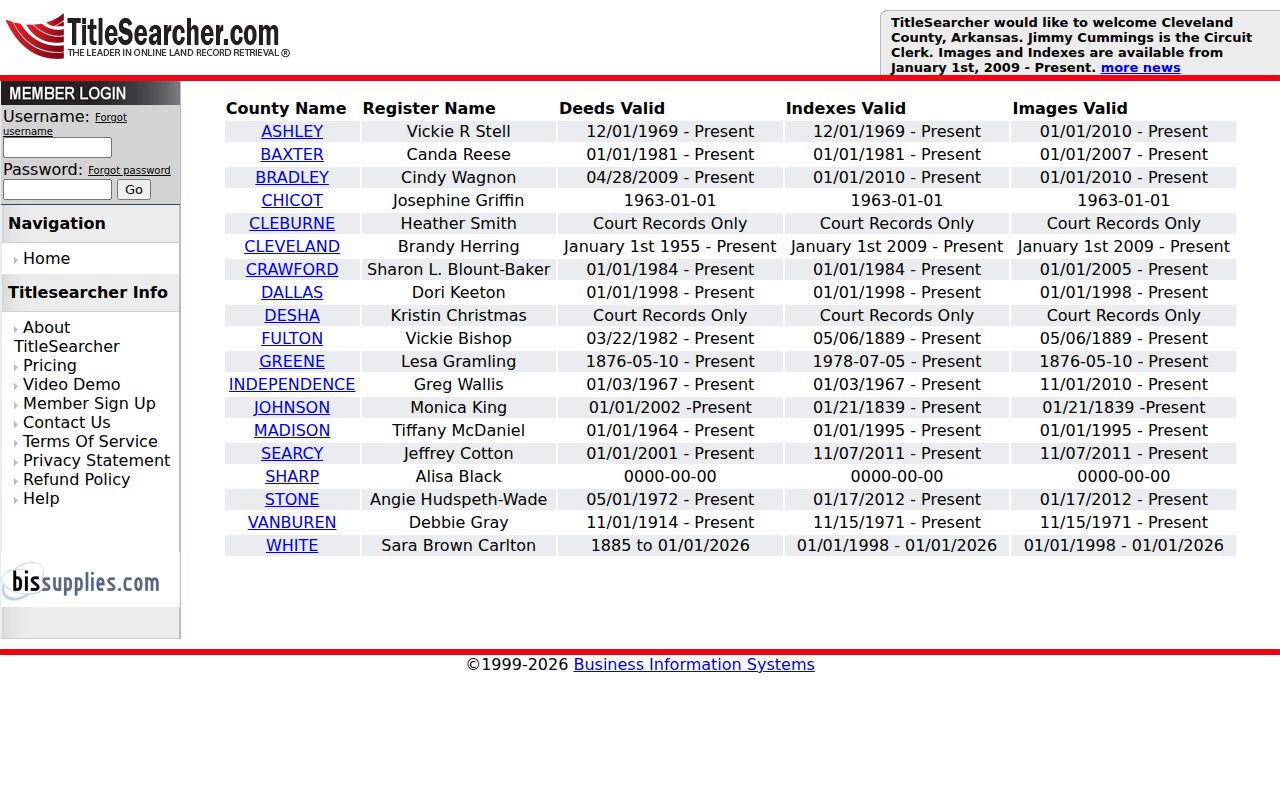
The image is a portal entry point, not proof that a specific White County deed or image has been verified.
Six Maps Date Searcy Blocks
Searcy has six verified Sanborn fire-insurance map editions: 1886, 1892, 1896, 1901, 1908, and 1919. The series grew from two sheets to thirteen. It can show whether a structure existed, how it was used, and how a street label or footprint changed. It does not name the people inside.
This map sequence is especially useful when a deed keeps a stable legal description but a street number seems to vanish. Compare the sheet index, building footprint, lot pattern, and nearby landmarks before deciding that a home was renumbered. No authoritative citywide Searcy renumbering year was found, so a mismatch should remain an open research question.
Note: A changed Searcy street number and a demolished building can look alike until maps, plats, and deeds are compared.
Pair Searcy Households by Decade
Deeds identify owners, not all past residents. The Searcy Public Library Arkansas Room supplies a second track through census access, local family histories, marriage microfilm before 1920, White County Heritage, and Searcy Daily Citizen microfilm beginning in July 1953. Exact publishers and year runs for a general Searcy city-directory series were not verified, so staff should be asked about telephone books or reverse directories before a visit.
- Fix the historic street label with a deed, plat, or Sanborn sheet.
- Ask for the closest directory or telephone-book year and copy its title and abbreviation key.
- Compare the address with a public federal census schedule through 1950.
- Use newspaper notices and obituaries to explain moves, deaths, or family links.
- Return to probate and deeds when ownership passes through an estate.
Details on the surviving publications belong with the Searcy directory book collections. For address history, record what each source actually says and leave blank years blank.
Probate Ends Searcy Resident Trails
When an owner dies, the deed chain may seem to stop. Probate petitions, estate files, and distribution deeds can identify heirs or explain how title moved. The White County Clerk handles probate, guardianship, and small-estate records at 315 N. Spruce. The Historical Society adds cemetery and death indexes, while library newspaper film can supply family context.
Federal litigation can also contain a property dispute or named-party clue, though a docket does not prove residence. The PACER federal court system is an account-based index and document service.

Use a federal case only as a cited lead, then return to the recorded deed and local file for the land history.
The Eastern District of Arkansas includes White County and publishes its own court information.
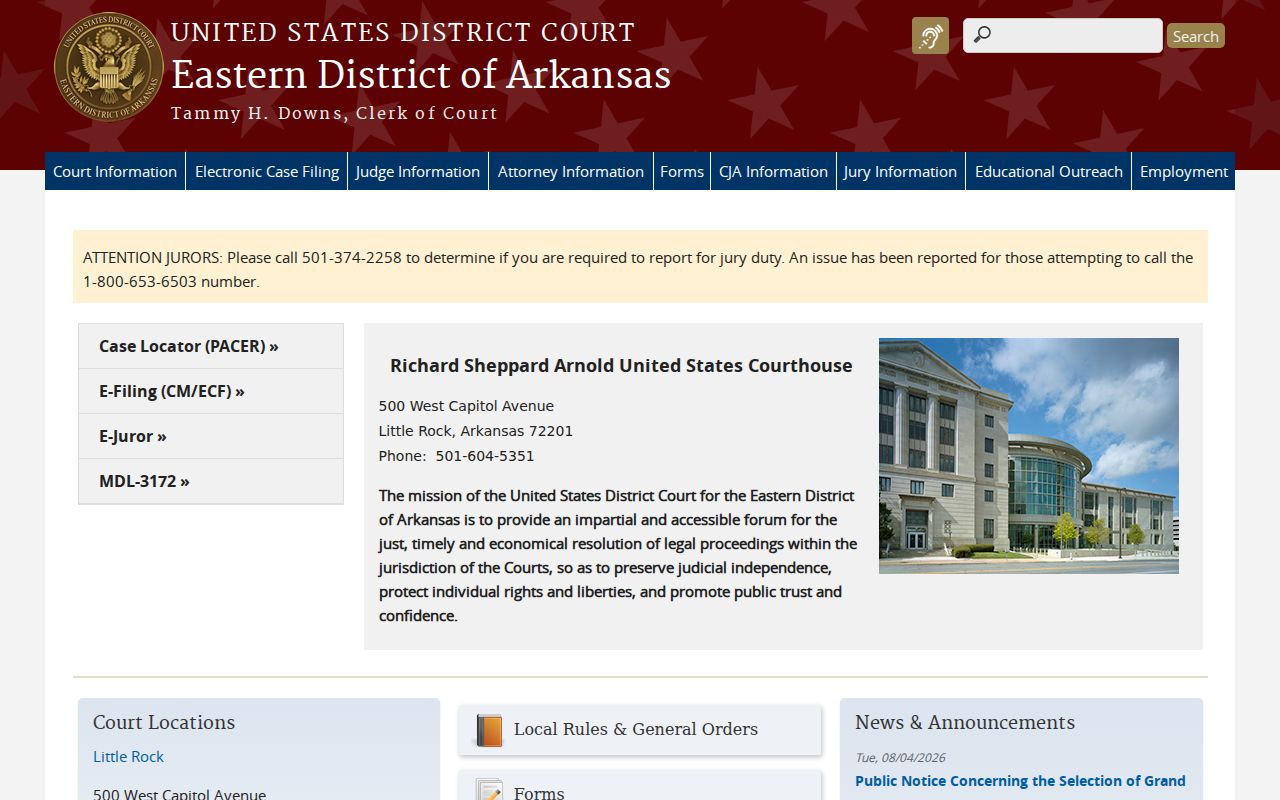
This district page helps identify the proper federal court, but local recorder and probate files remain the core Searcy sources.
Searcy Records Need White County
A catalog search for Searcy can drift into Searcy County, which is a different Arkansas jurisdiction. The city of Searcy is the seat of White County. Add “White County” and “Arkansas” to archive, census, deed, court, and newspaper queries. This small geography check prevents a convincing but wholly wrong line of previous residents.
Jurisdiction also shifts by date. White County was formed in 1835 from parts of Independence, Jackson, and Pulaski counties. Events before county formation may sit in a parent county, territorial file, or federal land record. Surviving White County material begins early: county-court and marriage records start in 1836, while deeds, circuit files, and tax records begin in 1837 in the state-archive inventory.
Restricted Searcy Records Stay Separate
A vital certificate may confirm a family event, but Arkansas does not make recent certificates open to all. Under Ark. Code Ann. §20-18-305 and 20 CAR §1-1501, birth records open to any person after 100 years; death, marriage, divorce, dissolution, and annulment records do so after 50 years when the request supplies enough identifying detail. Earlier access follows identity, relationship, and eligibility rules.
The Arkansas vital-record disclosure rule states the governing boundary.
The rule image is a reminder to request only records for which the searcher has a valid right of access. Historical indexes may supply a clue without granting access to the certificate itself.
Research Searcy Previous Residents Lawfully
A defensible house history labels each fact as ownership, occupancy evidence, family context, or a lead. It also preserves protected addresses. Arkansas Address Confidentiality Program participants use substitute-address safeguards, and public records should never be cross-matched to defeat that protection.
Use narrow requests when the portal fails. Ask the recorder for a deed by party and date, the County Clerk for a specific probate file, Searcy Planning for permits tied to one address, or the Arkansas Room for a defined newspaper period. This keeps the search accurate and makes each result easier to cite.
Lawful use. Trace Searcy previous residents for family history, estate research, or care for an old home. Never use a record to track, threaten, harass, or expose a living person.